
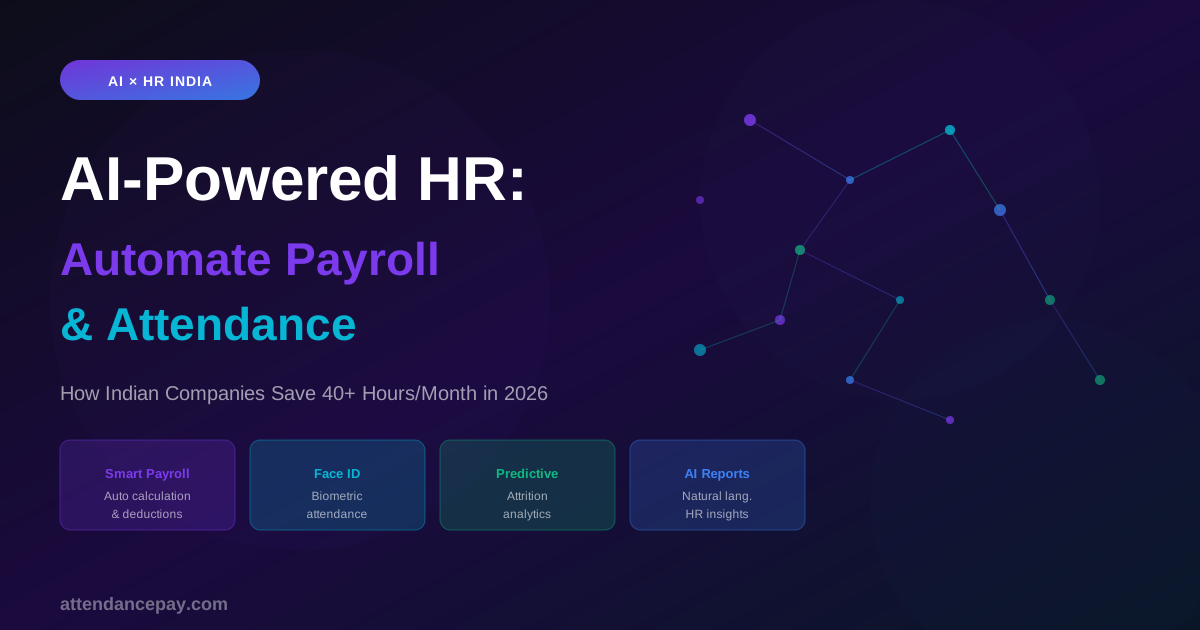
Why AI in HR Is No Longer Optional for Indian Companies
In 2026, Indian companies face a unique pressure: growing workforces, tighter compliance requirements, and rising employee expectations — all while HR teams remain understaffed. The average Indian HR professional manages 80–100 employees, versus a global average of 60.
AI doesn't replace HR. It handles the repetitive, error-prone work — so HR professionals can focus on what actually matters: people.
7 Ways AI Is Transforming HR Operations in India
1. Automated Payroll Calculation
Traditional payroll involves spreadsheets, manual entry, and hours of reconciliation. AI-powered payroll engines process payroll in minutes by automatically:
- Pulling attendance data from biometric devices and GPS apps
- Applying the correct salary components (basic, HRA, DA, special allowance)
- Calculating PF, ESIC, TDS, and professional tax based on current rules
- Flagging anomalies (e.g., employee on leave but marked present, salary jump >30%)
- Generating payslips and crediting salaries via bank transfer
Result: What took 3 days now takes 3 hours — and error rates drop to near-zero.
2. Intelligent Attendance Recognition
AI-powered attendance goes far beyond fingerprint scanners. In 2026, leading Indian HRMS platforms offer:
- Face recognition punch-in — No physical contact, works even with masks (liveness detection prevents photo spoofing)
- GPS + geofencing — Field employees punch in only when physically within the work zone
- Selfie attendance — Geotagged selfie with AI-verified location for WFH employees
- Anomaly detection — AI flags buddy punching, proxy attendance, and unusual patterns
3. Smart Leave Management
AI analyses leave patterns to predict staffing gaps before they happen. The system can:
- Auto-approve routine leave requests based on configured policies
- Alert managers when team availability drops below threshold
- Predict leave demand during festival seasons (Diwali, Dussehra, Eid)
- Suggest optimal leave scheduling to avoid production bottlenecks
4. AI-Assisted Recruitment
India's hiring market is competitive — top candidates get placed within 7 days. AI speeds up every stage:
- Resume screening — Parse 500 CVs in seconds, rank by job fit score
- Automated interview scheduling — AI coordinates calendars and sends invites
- Assessment scoring — Pre-built skill tests graded automatically
- Offer letter generation — Templated offer letters auto-filled with approved CTC
5. Real-Time HR Analytics Dashboard
Instead of quarterly HR reports, AI enables live dashboards that answer questions instantly:
- What is our current headcount by department and location?
- Which departments have the highest attrition risk?
- Are we overpaying or underpaying relative to market benchmarks?
- What is the average time-to-hire for each role?
- Which managers have the highest team satisfaction scores?
6. Employee Self-Service Chatbots
HR teams in India receive an average of 15–20 routine employee queries per day — leave balances, payslip downloads, policy questions. AI chatbots handle these 24/7 without human intervention. Employees get instant answers; HR gets their time back.
7. Predictive Attrition Analysis
Employee turnover costs 50–200% of the annual salary of the departing employee. AI can identify attrition risk 60–90 days in advance by analysing:
- Leave frequency and pattern changes
- Attendance irregularities
- Performance review sentiment
- Tenure vs. role progression
- Market salary benchmarks vs. current CTC
Real Numbers: ROI of AI-Powered HRMS for Indian Companies
| HR Task | Manual Time/Month | AI-Assisted Time | Time Saved |
|---|---|---|---|
| Payroll processing (100 emp.) | 18–24 hours | 2–3 hours | ~20 hours |
| Attendance reconciliation | 8–12 hours | Automatic | ~10 hours |
| Leave management queries | 4–6 hours | Self-service portal | ~5 hours |
| Compliance reporting | 6–8 hours | 1 hour | ~7 hours |
| Onboarding paperwork | 3–4 hours/hire | 30 min/hire | ~3.5 hours/hire |
Total savings for a 100-employee company: 40–50 hours every month. That's one full-time position freed up for strategic HR work.
Indian Companies Already Using AI-Powered HRMS
Across industries — IT services, manufacturing, retail, healthcare, logistics — Indian companies have moved from Excel-based HR to AI-powered HRMS. The shift is especially visible in:
- IT/ITES companies (10–500 employees): AI payroll + attendance replacing manual tracking
- Manufacturing units: Biometric + GPS tracking across multiple plant locations
- Retail chains: Shift scheduling automation and real-time headcount dashboards
- Field service companies: GPS attendance for technicians and sales teams
- Construction firms: Daily wage calculation + ESIC compliance for contract workers
What to Look for in an AI-Powered HRMS for Indian Companies
- India-specific compliance — PF, ESIC, TDS, PT, gratuity, and new Labour Codes built-in
- Multiple attendance modes — Biometric, GPS, geofencing, selfie, web punch
- Mobile-first — Employees and managers should be able to do everything from a smartphone
- Multi-location support — Different policies for different branches, states, or client sites
- Real-time dashboards — Live data, not monthly reports
- Transparent pricing — No per-module fees for core HR features
Conclusion
AI in HR isn't a future trend — it's a present-day competitive advantage. Indian companies that automate routine HR tasks in 2026 will operate leaner, stay more compliant, and retain better talent than those still running on spreadsheets.
AttendancePay is built from the ground up for Indian companies — with AI-assisted payroll, GPS attendance, geofencing, and complete compliance for PF, ESIC, TDS, and the new Labour Codes.
Ready to automate your HR? Start free today — no credit card required, set up in under 30 minutes.
Related reading: See how this works for IT & services companies, or calculate take-home pay with our Salary Calculator.