What Are the 4 New Labour Codes?
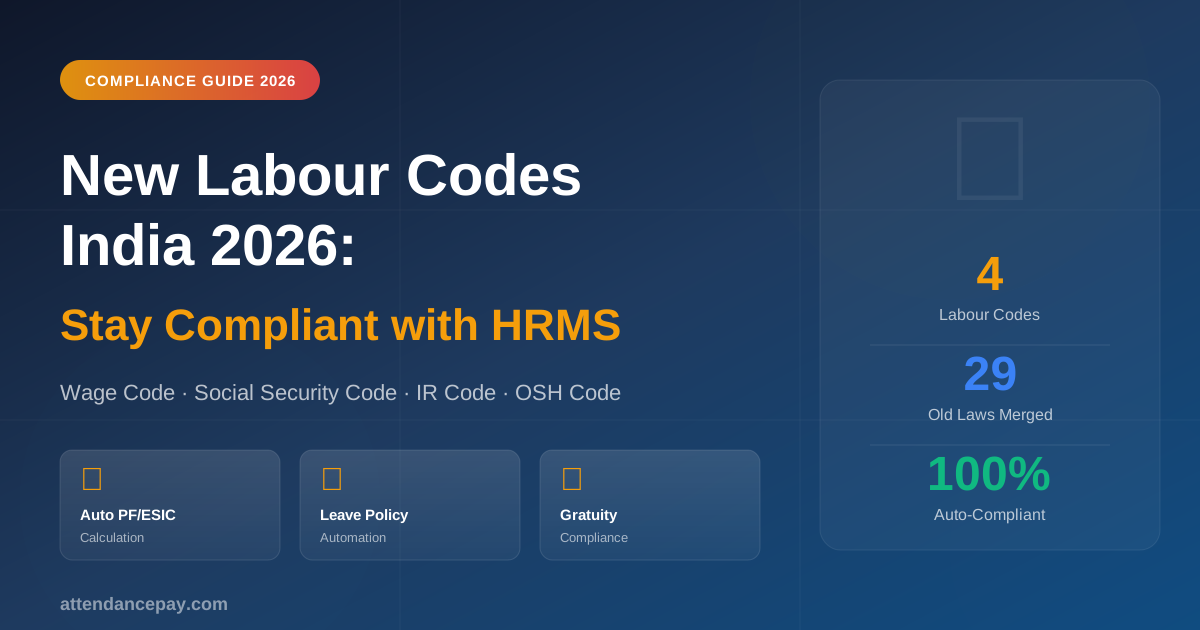
After decades of complex and overlapping legislation, the Government of India consolidated 29 central labour laws into 4 comprehensive Labour Codes. While the notification has been issued, implementation timelines vary by state — making it critical for HR teams to prepare now.
- Code on Wages, 2019 — Governs minimum wage, equal remuneration, payment of wages, and bonus
- Industrial Relations Code, 2020 — Covers trade unions, industrial disputes, standing orders
- Social Security Code, 2020 — Merges PF, ESI, gratuity, maternity benefit, and unorganised workers
- Occupational Safety, Health & Working Conditions Code, 2020 — Governs working hours, leave, safety standards
The 7 Biggest Changes HR Managers Must Know
1. New Definition of "Wages" Changes Everything
The new Wage Code introduces a uniform definition of "wages" that directly impacts PF, gratuity, and ESIC calculations. Key rule: basic pay must be at least 50% of CTC. Many Indian companies structured salary with a low basic (20–30%) to reduce PF liability — that is no longer compliant.
What to do: Audit all salary structures immediately. If basic pay is below 50% of CTC, restructure before implementation. Your HRMS should auto-flag non-compliant structures.
2. 4-Day Work Week Is Now Possible (With a Catch)
The OSH Code allows employees to work 4 days a week with 12-hour days — but total weekly hours remain capped at 48. Overtime rules also become stricter: any hours beyond 48/week must be compensated at 2X the wage rate.
Impact: Shift scheduling, overtime tracking, and attendance systems must support flexible work week configurations.
3. Leaves Are Consolidated (and Encashment Rules Change)
The OSH Code sets a minimum of 1 earned leave for every 20 days of work. Previous rules varied wildly across industries. Additionally:
- Leave encashment is now mandatory on termination or resignation
- Employees can carry forward unlimited earned leaves (the 30-day cap is removed in many interpretations)
- Leave balance must be reflected in payslips
4. Gratuity Eligibility Drops to 1 Year for Contract Workers
Under the Social Security Code, fixed-term contract employees become eligible for gratuity after just 1 year (vs. 5 years for permanent employees). This is a major change for industries that rely heavily on contract labour.
5. ESIC Extended to All States and More Industries
The Social Security Code extends ESIC to all geographical areas and additional industries, including construction, seasonal establishments, and unorganised sector workers. Contribution thresholds may also be revised upward.
6. New Bonus Rules
The Wage Code potentially revises the bonus eligibility salary ceiling and calculation base. HR teams must ensure bonus computation is updated in payroll systems before the fiscal year-end.
7. Stricter Penalty for Non-Compliance
The new codes introduce unified penalty structures. Non-compliance with wage payment rules can result in fines up to ₹50,000 for first offences and ₹1,00,000 for repeat violations — plus potential imprisonment for senior management.
State-wise Implementation Status (June 2026)
As of 2026, implementation varies significantly by state:
- Fully notified: Madhya Pradesh, Uttar Pradesh, Haryana, Gujarat, Karnataka
- Partially notified: Maharashtra, Tamil Nadu, Rajasthan, Telangana
- Pending: West Bengal, Kerala, Delhi (under review)
Even where state rules are pending, companies should implement the central code requirements — it is safer and future-proofs your HR processes.
How HRMS Software Handles Labour Code Compliance Automatically
Manual compliance tracking across 4 codes for 100+ employees is practically impossible. Modern HRMS platforms like AttendancePay handle this automatically:
Automatic Wage Structure Validation
AttendancePay automatically checks whether basic pay meets the 50% threshold when you create or update a salary structure. Non-compliant structures are flagged before payroll runs — not after a government audit.
Smart Leave Management
Configure any leave policy — 4-day week, 5-day week, industry-specific rules — and let the system calculate accruals, carry-forwards, and encashment automatically. Leave balances appear on every employee's payslip.
PF/ESIC Auto-Calculation on New Wage Definition
Our payroll engine applies the new wage definition for PF and ESIC calculations. When you update a salary component, the system recalculates all statutory deductions in real time.
Gratuity Provisioning for Contract Workers
Set different gratuity eligibility rules for permanent and fixed-term employees. AttendancePay automatically provisions gratuity liability and shows it in each employee's profile.
Overtime Tracking at 2X
Configure overtime pay rates per shift or per employee type. The attendance module captures extra hours and payroll automatically calculates overtime wages at the correct rate.
Your 5-Step Labour Code Compliance Action Plan
- Audit salary structures — Identify all employees where basic < 50% of CTC
- Update leave policies — Align with the 1-in-20 earned leave rule and encashment requirements
- Review contract worker gratuity — Add 1-year eligibility for fixed-term staff
- Configure overtime rules — Set 2X pay triggers in your attendance/payroll system
- Run a test payroll — Process one month under the new rules before full rollout
Frequently Asked Questions
Q: When do the Labour Codes come into effect?
The central government has notified all 4 codes. Implementation depends on state rules. Most HR experts recommend complying now — early adoption protects you from penalties and gives your team time to adjust.
Q: Does the 50% basic pay rule apply to all companies?
Yes, for all employers covered under the Wage Code — which includes virtually all establishments with employees.
Q: Can we restructure salary to maintain take-home pay?
Yes, but it must be done carefully. Increasing basic pay increases PF and gratuity liability. Use your HRMS to model the financial impact before making changes.
Q: What if our state hasn't notified the rules yet?
Follow the central code. State rules generally mirror the central code with minor tweaks. Getting compliant with the central code now means minimal adjustment when your state notifies.
Conclusion
India's Labour Codes are the most significant reform in employment law in decades. While the transition period can feel overwhelming, the right HRMS eliminates most of the manual burden. Configure your salary structures, leave policies, and payroll engine once — and let the software handle compliance automatically, month after month.
Want to see how AttendancePay handles Labour Code compliance end-to-end? Start your free trial or schedule a demo.
Related tools: Track every statutory deadline with our Payroll Compliance Calendar, and calculate contributions with the PF Calculator.