The Hybrid Work Reality in India (2026)
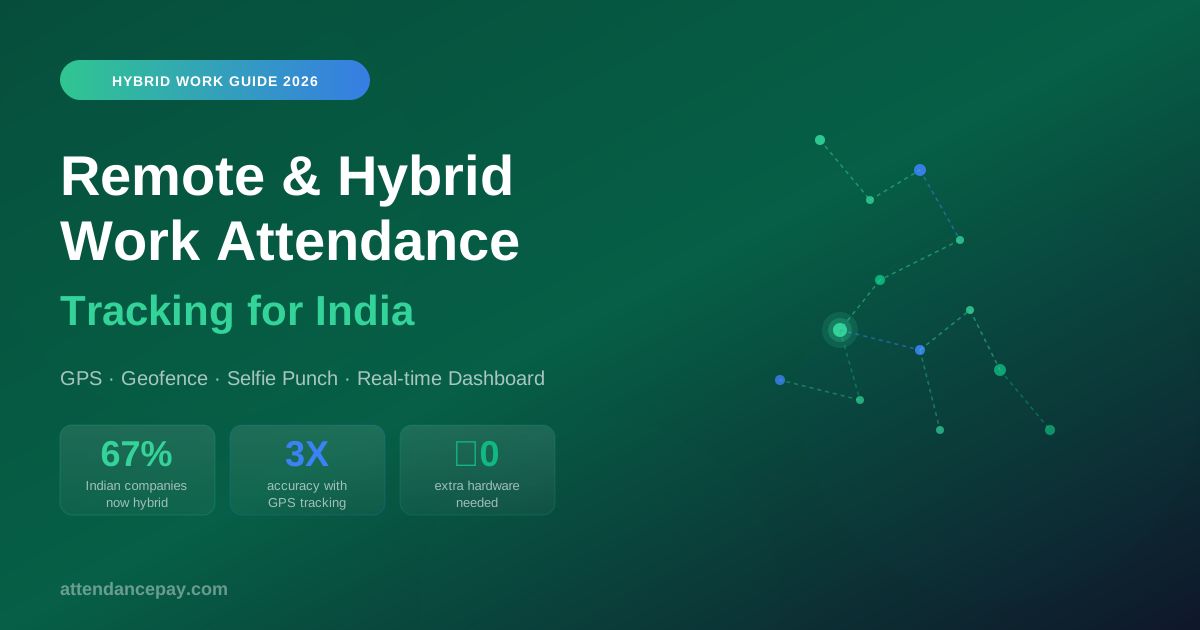
Remote and hybrid work is no longer an emergency measure — it's the permanent operating model for a large share of Indian companies. According to recent surveys, 67% of Indian white-collar companies now operate on a hybrid schedule, and 38% of IT and services companies are fully remote-first.
Yet most HR teams are still trying to manage this reality with attendance systems designed for a single-office world — punch cards, biometric devices, or worse, WhatsApp check-ins. The result: inaccurate data, compliance gaps, and frustrated employees.
The 5 Problems with Traditional Attendance for Hybrid Teams
- No visibility of WFH attendance — "Trust me, I was working" is not an attendance record
- Field staff accountability gaps — Sales, delivery, and service teams have no verifiable check-in
- Payroll errors from manual data — Manual attendance → manual payroll → avoidable errors
- Compliance exposure — Labour law audits require verified attendance records; WhatsApp messages don't qualify
- Multi-location chaos — Different offices, client sites, home offices, and co-working spaces make centralized tracking impossible without technology
The Modern Solution: Location-Intelligent Attendance
Modern HRMS platforms solve hybrid attendance through a combination of four technologies. You don't need all four — you pick what fits your team structure.
1. GPS-Based Punch-In/Punch-Out
The simplest solution for field teams. The employee opens the app, hits "Check In" — and the system records their GPS coordinates, timestamp, and location name. No device, no token, no hardware required.
Best for: Sales teams, delivery staff, field technicians, client-site employees
How it works in AttendancePay:
- Employee punches in via the mobile app
- GPS coordinates are captured and stored
- Location is reverse-geocoded to show the actual address
- Manager sees a live map of where each team member checked in
- Attendance auto-flows to payroll at month-end
2. Geofencing (Location-Locked Attendance)
A virtual boundary drawn around your office, warehouse, factory, or client site. Employees can only mark attendance when they are physically inside the geofence. The moment they leave, the system automatically marks them out.
Best for: Offices, factories, warehouses, retail stores, hospitals
Configuration in AttendancePay:
- Draw geofence radius (50m to 5km) around any location on a map
- Set multiple geofences for multiple offices
- Employees outside the zone see an error when they try to punch in
- Managers get alerts for attempts to punch from unauthorized locations
3. Selfie Attendance with Geotag
For WFH employees, selfie attendance provides a human-readable verification that the employee is actually working. The system captures:
- A photo of the employee (with AI liveness detection to prevent static photos)
- GPS coordinates at the time of the selfie
- Timestamp in IST
Best for: WFH employees, consultants, remote-first teams
4. Web-Based Punch (Browser Check-In)
For office employees working on desktops or laptops, browser-based check-in captures IP address and optional location permission. Ideal for shared-office environments where biometric devices create queues.
Live Tracking: Beyond Attendance to Real-Time Visibility
For companies with field staff — delivery executives, sales teams, service engineers — live GPS tracking provides real-time visibility that goes beyond just check-in/check-out.
AttendancePay's live tracking dashboard shows:
- Current location of each field employee on a map
- Movement trail throughout the day
- Time spent at each client location
- Distance travelled (for mileage reimbursement)
- Live status — checked in, on break, checked out
Setting Up Hybrid Attendance Policies in HRMS
One size doesn't fit all in a hybrid world. Modern HRMS lets you configure different attendance rules for different employee groups:
Policy Configuration Examples
| Employee Type | Recommended Mode | Verification |
|---|---|---|
| Office staff (daily) | Geofencing | Location-locked |
| Hybrid employees (3 days office) | Geofence + Selfie | Auto-detect location |
| Full WFH employees | Selfie with GPS | Photo + location |
| Field sales / delivery | GPS punch + Live tracking | Continuous trail |
| Factory / warehouse | Biometric + Geofence | Dual verification |
How Hybrid Attendance Feeds into Payroll
The real power of digital attendance tracking is the automatic connection to payroll. Once attendance data is captured:
- Present days, half-days, absences, and late arrivals are calculated automatically
- Leave balances are updated in real time
- Overtime hours (from GPS timestamps) flow directly to salary calculations
- Travel allowances are computed from distance data
- Month-end payroll runs in minutes — no manual reconciliation
Compliance Angle: Why Verified Attendance Is Non-Negotiable
Under India's new Labour Codes and legacy laws like the Shops & Establishments Act, employers must maintain accurate attendance records for each employee. In case of a labour dispute or inspection:
- WhatsApp messages are not legally admissible
- Manual registers can be tampered with
- GPS-timestamped digital records are auditable, tamper-proof, and printable
AttendancePay stores all attendance records with UTC timestamps, employee IDs, device IDs, and GPS coordinates — creating an audit trail that meets any inspection requirement.
Implementation Guide: Getting Your Hybrid Team on Digital Attendance
Week 1: Setup
- Create employee profiles in HRMS
- Assign attendance policies by employee group
- Set geofences for each office location
- Configure shift timings and working hours
Week 2: Pilot
- Roll out to one department or one location first
- Collect feedback on mobile app usability
- Verify that GPS accuracy meets your requirements
- Run a parallel check against your existing system
Week 3–4: Full Rollout
- Onboard all employees via app (5-minute setup per person)
- Run first automated payroll using digital attendance data
- Review anomaly reports and address exceptions
- Decommission your old attendance system
Common Questions from Indian HR Managers
Q: What if employees' GPS is turned off?
AttendancePay requires location permission to punch in. If GPS is off, the app prompts the employee to enable it. Managers can see which employees have location restrictions active.
Q: Does it work in areas with poor internet connectivity?
Yes — the mobile app captures attendance offline and syncs when connectivity is restored. Data is timestamped at the time of punch-in, not at sync time.
Q: Can employees game the GPS?
The system detects fake GPS apps (mock location providers). Suspicious check-ins are flagged for manager review.
Q: What about privacy — is location tracking legal in India?
Yes, with employee consent and clear communication. Location is only tracked during work hours when the employee actively checks in. The app is not a continuous background tracker.
Conclusion
Hybrid work is here to stay in India. The companies that thrive in this model will be those that give their employees flexibility without sacrificing accountability — and that is exactly what modern location-intelligent attendance systems deliver.
AttendancePay supports every attendance mode — GPS, geofencing, selfie, biometric integration, and web punch — from a single platform, with full payroll and compliance built in.
Set up your hybrid attendance system in under an hour. Start your free trial — no hardware, no setup fees, mobile-ready from day one.
Related reading: See dedicated guidance for IT & services teams and multi-location enterprises managing hybrid attendance.